Cat Enclosures

Catio shelves, ramps and tunnels

Shelves, ramps, platforms and mesh tunnels added to new or existing cat enclosures, giving cats more height, routes and things to explore. UK costs.

In short: Catio shelves, ramps and tunnels are add-ons that give cats more height, more routes and more to explore, including platforms, scratching posts, shelters and mesh tunnels linking separate areas. They suit owners with a new or existing catio that their cats are not using fully. Small add-ons typically cost from around £50 to £300, with mesh tunnels often £50 to £150 per metre installed in the UK.

Get a free quote

Fixed price, no obligation. We aim to reply the same day.

By sending this form you agree to be contacted about your enquiry. See our privacy policy.

Catio shelves, ramps and tunnels

Cats live in three dimensions. An enclosure with a bare floor is far less interesting to a cat than a smaller one with shelves at different heights, a high lookout, a hidey box and a scratching post. Height also helps in multi-cat homes, because cats can keep their distance from each other without leaving. Adding platforms and routes is often the quickest way to make an existing catio feel bigger and get your cats to use it.

Tunnels connect spaces. A mesh tunnel can run from a window or cat flap to a catio further down the garden, link two separate enclosures, or loop round a lawn to give cats a patrol route. Tunnels need the same strong mesh and secure joins as the main enclosure, and should be wide enough for a cat to turn round. Ramps suit elderly cats and cats with arthritis, who may struggle with jumps between shelves.

What is included

  • Shelves and platforms fixed at staggered heights
  • Ramps with grip for older or less mobile cats
  • Mesh tunnels linking a window, cat flap or separate enclosures
  • Scratching posts and sisal-wrapped uprights
  • Hide boxes and weatherproof shelters
  • Sun and shade shelters on exposed enclosures
  • Check that new routes do not create escape or climbing points

Who it is for

  • Existing catios that cats are not using much
  • Multi-cat homes where cats need room to avoid each other
  • Elderly or arthritic cats that need ramps instead of jumps
  • Gardens where a tunnel can link the house to a catio further away
  • Owners extending a kit or bespoke enclosure

How much does it cost?

As a guide, small add-ons such as shelves, ramps and scratching posts typically cost £50 to £300 fitted, while mesh tunnels often cost £50 to £150 per metre installed in the UK, depending on length, height and route. See our full cost guide.
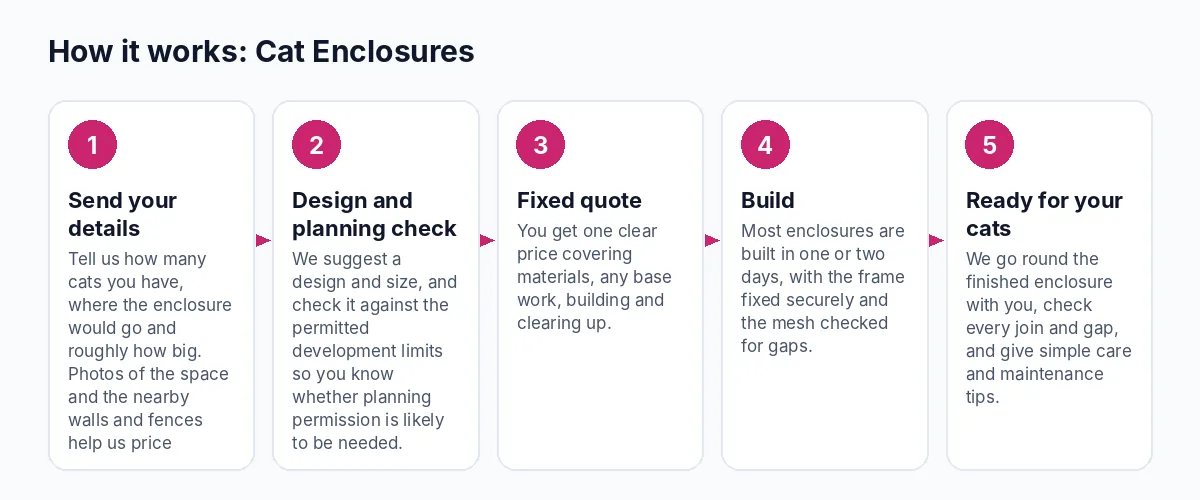
How it works

How catio shelves, ramps and tunnels works, step by step
  1. Watch how your cats use the space

    We look at where your cats sit, what they avoid and how mobile they are, then suggest additions to suit.

  2. Plan routes and heights

    Shelves, ramps and tunnels are laid out so there are several ways up and down, with no dead ends in multi-cat homes.

  3. Build and fix securely

    Every add-on is fixed to the frame or wall so it cannot wobble or fall, with no sharp edges or exposed screw tips.

  4. Re-check escape points

    New shelves can give cats a launch point, so the mesh and roof near every addition are checked again.

Catio shelves, ramps and tunnels: FAQs

How high should catio shelves be?

Stagger them so a cat can step or make short jumps between them, usually 30 to 45 centimetres apart in height. The top shelf can be close to the roof, as long as there is room for the cat to sit up. For older cats, keep gaps smaller and add a ramp. Shelves should be at least 25 centimetres deep so a cat can lie on them comfortably.

How wide should a cat tunnel be?

Most cat tunnels are around 30 to 45 centimetres square, which lets a cat walk, turn and pass another cat. Long tunnels benefit from a wider resting point or platform part way along. Avoid very narrow tunnels in multi-cat homes, as one cat can block another.

Can you add shelves to a kit catio?

Usually, yes. Shelves can be screwed to the frame uprights, as long as the frame is strong enough to take the load of a jumping cat. Thin kit frames sometimes need an extra upright or bracing first. Avoid fixing shelves into the mesh alone.

What materials are safe for catio shelves?

Untreated or pet-safe treated timber, exterior plywood and composite boards all work. Avoid leaving bare pressure-treated timber where cats chew, and give smooth shelves a carpet tile or textured surface for grip. Any preservative or paint should be fully dry and labelled safe for use around animals before cats use the enclosure.

Get a quote for catio shelves, ramps and tunnels

Send a few details and get one clear, fixed price, usually the same day.

Get a quote

Last updated 6 November 2026